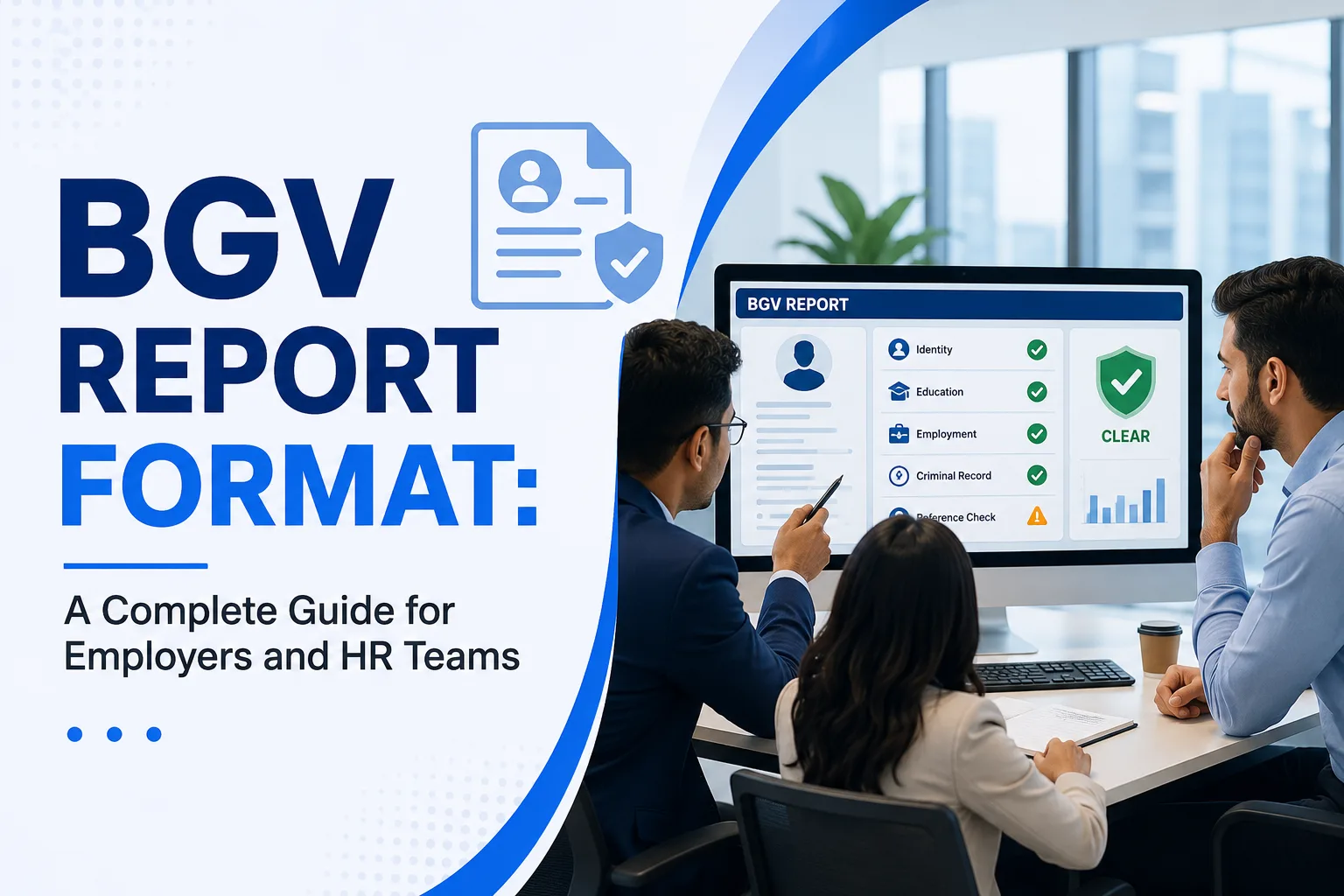

A BGV consent form is a written authorisation signed by a job candidate that permits an employer or third-party background verification agency to access and verify their personal, educational, and employment records. It establishes legal compliance, protects candidate privacy, and is a mandatory first step before any background check can be initiated. From startup to enterprise, this form is not only a best practice, but it’s also a legal and operational necessity.
By the numbers
Based on an analysis of over one million background checks across sectors in India, KPMG found that the average discrepancy rate across all industries is approximately 11%, with Financial Services at 15%, Infrastructure and Logistics at a staggering 31%, and Technology at 10%.
What Is a BGV Consent Form and Why Does It Matter?
A BGV consent form is a document signed by a candidate to give a third party (such as a background check company) or an employer access to personal records for background checks, which is legally binding. These records can contain information on employment, education, criminal, credit, and identity.
The BGV consent form has two basic functions. First, it is a legal safeguard for the organisation as it provides documented evidence of the candidate’s voluntary agreement. Second, it ensures that the candidate’s privacy is safeguarded by specifying the data collection’s scope and purpose.
In India, with the Digital Personal Data Protection Act (DPDPA) 2023 now operationalised through DPDP Rules notified in November 2025, the stakes around proper consent have never been higher. An improperly executed BGV consent form can expose organisations to regulatory penalties, reputational damage, and legal disputes with candidates.
The Legal Framework Behind a BGV Consent Form
DPDPA and the Consent Imperative
The DPDP Rules 2025 (notified November 14, 2025) fundamentally shifted how Indian organisations must handle candidate data. Under this law, collecting, processing, or sharing personal data without explicit consent is a violation. For HR and compliance teams, this means every BGV consent form must now qualify as DPDP compliant consent, structured, specific, and freely given.
DPDP compliant consent is not one moment; it is a journey across multiple HR touchpoints. It must be:
- Free: If a candidate feels they must agree to data collection to receive their offer or move forward in the process, that agreement does not meet the legal standard.
- Specific: clearly stating what data is collected and for what purpose
- Informed: candidates must understand their rights, including the right to withdraw
- Unambiguous: silence, inactivity, or pre-ticked boxes are explicitly invalid under the DPDP Act
The Five-Stage DPDP Compliant Consent Flow for HR
A BGV consent form is not a standalone document; it is one stage in a layered consent architecture. DPDP compliance framework, every HR team should implement a five-stage consent flow:
Stage 1: Awareness (JD / Careers Page): Set expectations before candidates share any data. A simple data notice on the job description, stating that personal data will be processed for recruitment purposes in accordance with applicable laws, is mandatory.
Stage 2: Explicit Consent (Application Stage): Use an unchecked checkbox with a single, specific purpose. Never club consent with Terms & Conditions. Never use pre-ticked boxes.
Stage 3: Purpose-Specific BGV Consent: BGV always requires a fresh, standalone consent. Earlier hiring consent does not automatically extend to background verification. The BGV consent form must explicitly name the verification purpose: identity, employment history, address, or criminal records and confirm that data will not be used for any other purpose.
Stage 4: Consent Confirmation Email (Traceable Proof): A written email confirming what consent was given, for what purpose, and how it can be withdrawn serves as your auditable proof record.
Stage 5: Retention + Deletion Alignment: Consent records must be linked to a purpose-end trigger. The DPDP Rules 2025 recommend a 180-day data deletion policy for BGV-related records post-process completion.
Key Components of a Legally Sound BGV Consent Form
A well-drafted BGV consent form is more than a signature box. It is a structured consent document that must include:
- Candidate Identification: Full name, date of birth, contact details, and government-issued ID references, anchoring the consent to a specific individual.
- Scope of Verification: Every check category must be explicitly named. An employment background check consent form that uses vague language like “we may conduct checks as required” is invalid under DPDP. Valid wording: “I consent to background verification for employment eligibility, including identity, employment history, and criminal record verification.”
- Purpose Statement: Clearly state that data will be used solely to verify the candidate’s suitability for the applied position, and for no other purpose.
- Data Sharing and Retention Policy: Specify whether data will be shared with third-party verification agencies, how long it will be retained, and when it will be deleted. This is a non-negotiable element of any DPDP compliant consent framework.
- Candidate Rights: Include a clear statement of the candidate’s right to withdraw consent, access their data, and seek correction of inaccurate records. A named Grievance Officer must be designated, with a response Service-Level Agreement (SLA) of 90 days for all Data Principal requests.
- Signature and Date: Digital and physical signatures are both valid when the mechanism is auditable. Timestamped e-signatures with Internet Protocol (IP) logging provide the strongest legal defensibility.
Understanding the Background Check Consent Form Template
Most HR teams source their consent forms from online templates. That is also where compliance risk begins.
A template built for US or UK requirements will not meet DPDPA standards. The legal frameworks differ; what satisfies the FCRA or the GDPR does not automatically satisfy India’s Digital Personal Data Protection Act. Using such a template without adaptation means the organisation may be collecting candidate data on a consent form that is legally invalid under Indian law.
When customising a template, ensure it incorporates:
- Reference to the DPDPA 2023 and DPDP Rules 2025, with candidate rights clearly enumerated
- Language that qualifies the consent as DPDP compliant consent
- A data fiduciary declaration identifying your organisation as the processing entity
- Separate checkboxes for each purpose, payroll, BGV, and onboarding communications rather than a single bundled consent
- A visible, easy-to-use withdrawal mechanism in every form
The Employment Background Check Consent Form: Tailoring It for Different Roles
Not all hires carry the same risk profile. An employment background check consent form for a senior finance executive will look materially different from one used for an entry-level operations hire. The principle of data minimisation, collecting only what is necessary for the specific role, applies here.
Sector-specific fraud risk: KPMG’s analysis analysis of over one million checks reveals sharply varying discrepancy rates: Infrastructure and Logistics records a 31% discrepancy rate driven by informal hiring practices; Financial Services follows at 15% due to comprehensive compliance mandates; Technology records 10%, with discrepancies concentrated in entry-to-mid-level roles. Notably, 32% of resume fraudsters in India fall in the 26–35 age group meaning mid-career hiring warrants heightened scrutiny and more detailed consent scope.
Segmenting your BGV consent form by role category not only reduces legal exposure but also improves the candidate experience by avoiding unnecessary data collection, a core DPDP principle.
Consent Form for Criminal Background Check: A Special Case
The consent form for a criminal background check requires particular care. Criminal history is sensitive personal data, and accessing it without clear, specific, written consent is a serious violation. A generic BGV consent form that bundles criminal checks with other verifications without naming them explicitly does not meet the informed consent standard under DPDP.
The consent form for a criminal background check must:
- Explicitly name the check type (e.g., police verification, eCourt database search, court record check)
- Specify jurisdictions covered
- State how results will factor into hiring decisions
- Include the candidate’s right to dispute inaccurate findings
In sectors such as BFSI, healthcare, and childcare, a dedicated consent form for criminal background check is a regulatory expectation, not a best practice.
Common Mistakes HR Teams Make with BGV Consent Forms
Even experienced HR professionals routinely make errors that undermine the legal validity of their BGV consent form. The most common pitfalls, as documented across DPDP compliance frameworks, include:
- Bundling consent with offer letters. the BGV consent form must never be embedded in an offer letter. This conflates employment acceptance with data processing authorisation, a combination that the DPDP Act directly invalidates.
- Reusing hiring consent for BGV. BGV always requires fresh, standalone consent. Earlier application-stage consent does not carry forward.
- Using vague language. “By continuing, you agree…” or “We may conduct checks as required” are explicitly invalid under DPDP. Purpose, scope, and choice must all appear in the consent wording.
- No withdrawal mechanism. Withdrawal must be as easy as giving consent. A withdrawal contact email or mechanism must appear on every BGV consent form.
- Poor record-keeping. Consent logs must be stored securely and retrievably. The Data Protection Board of India (DPBI) can and will request them immediately upon any investigation. Organisations that cannot produce auditable consent records face the maximum penalty tier.
Internal HR Workflow: Making BGV Consent Operationally Sound
A signed BGV consent form is only as strong as the workflow behind it. A compliant internal structure requires:
- Applicant Tracking System (ATS) is capturing hiring consent at the application stage
- HR triggering a separate BGV consent before verification begins
- Vendors unable to initiate verification without a valid consent ID on file
- Consent records stored centrally with role-based access controls
- A retention clock linked to purpose-end, with automated deletion triggers
Consent without workflow is compliance theatre. The document matters but only when backed by operational systems that enforce it.
Conclusion
The BGV consent form sits at the intersection of legal compliance, candidate experience, and organisational trust. HR and compliance teams that build thoughtful, specific, and fully DPDP compliant consent mechanisms, anchored in a layered consent flow, role-segmented forms, and auditable record-keeping, will not only stay on the right side of the law. They will signal to every candidate that their data is handled with genuine respect and responsibility.
Whether you are drafting your first BGV consent form or auditing an existing process, the standard is the same: be specific, be transparent, and be compliant. Your hiring process depends on it.
FAQs
No. Application-stage consent does not extend to background verification. The DPDP Act requires fresh, standalone consent for each distinct processing purpose. BGV must have its own separate consent form that explicitly names the verification checks being conducted.
Yes. Under the DPDP Act 2023, candidates have the right to withdraw consent at any time. Withdrawal must be as easy as giving consent, and every BGV consent form must include a clearly visible mechanism, such as a withdrawal email address, for exercising this right.
Yes. Criminal history is sensitive personal data. A generic BGV consent form that bundles criminal checks with other verifications without naming them explicitly does not meet the informed consent standard under DPDP. A dedicated, clearly worded consent clause or a separate form is required for any criminal record check.