Your next great hire could already be posting red flags, right now, publicly, on the internet.
With the modern era being defined by the fact that the image of a candidate is not restricted to just his/her résumé, companies in India have realised the need to undertake social media background verification for potential recruits. A candidate’s activities online through social media can sometimes carry as much weight as his/her work experience or academic qualifications.
However, despite its widespread use, the fact still persists that it is one of the least understood and often incorrectly performed checks in the realm of hiring in India. Most organisations consider it more of a ‘Google’ search, and that leads to potential risks.
This blog breaks down why social media background checks in India have moved from “nice to have” to operationally essential and what your organisation needs to know before building this into your screening framework.
What Are Social Media Background Checks?
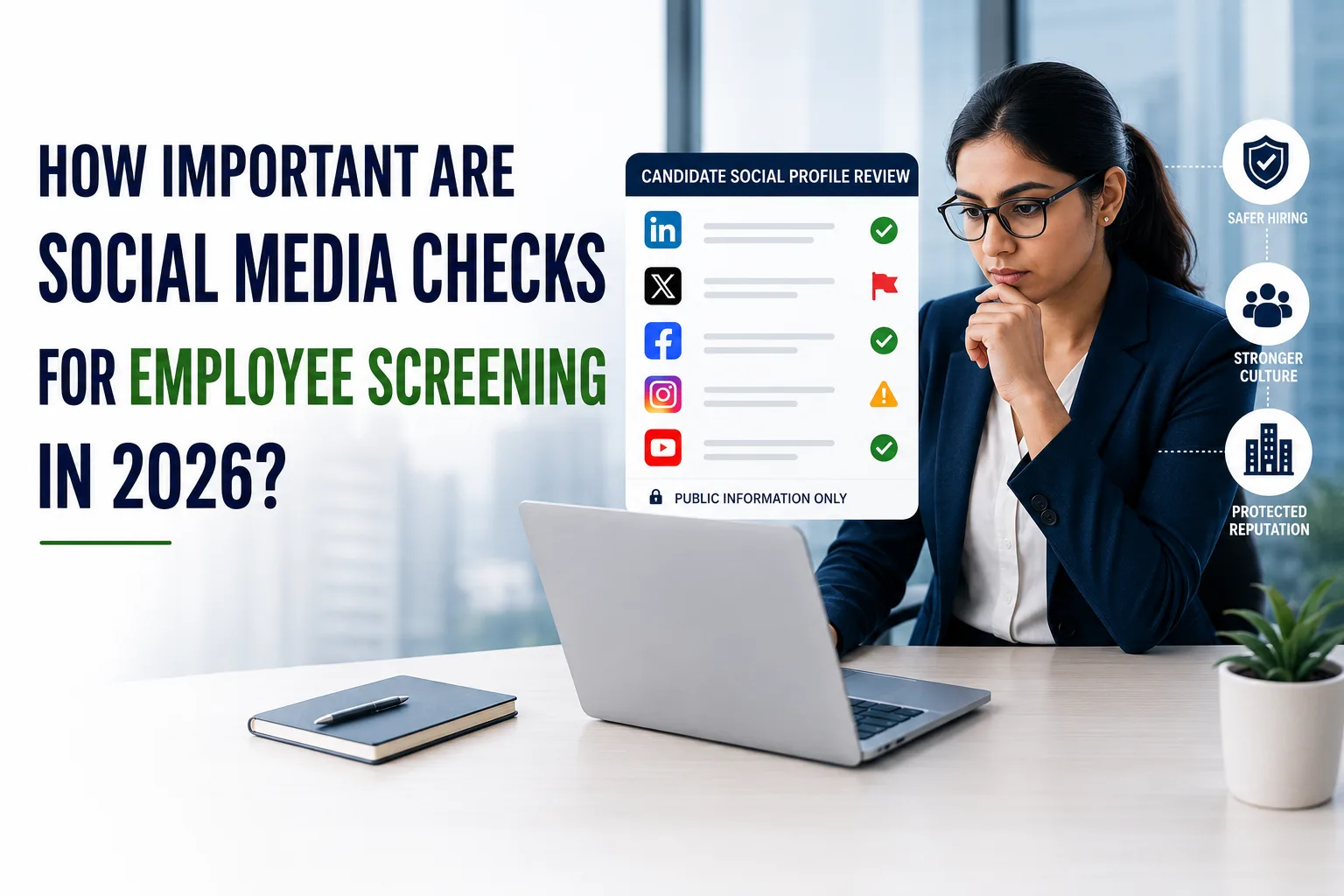
Social media background checks in India refer to the structured review of a candidate’s publicly available online presence, across platforms such as LinkedIn, Twitter/X, Facebook, Instagram, and YouTube, to identify behaviours, statements, or patterns that could pose a risk to the organisation.
Unlike an informal browse through someone’s Instagram, professional social media screening for employees follows a defined scope: It is based on consent, written down, relevant to one’s job role, and assessed against set risk criteria and not personal opinion. This process is not about judging someone’s way of life but uncovering possible issues that may arise within a professional context.
Online reputation screening as a discipline looks at how a candidate presents themselves in digital public spaces: The manner in which they communicate, the groups they relate to, the causes they support or reject, and whether what they claim to value resonates with the values of the recruiting company. It is an intelligence layer that is systematic in nature, one that goes beyond mere qualifications and shines light on the individual’s true nature.
Why Social Media Screening Has Become Critical in India
India’s workforce is deeply digital. With over 900 million internet users and social media penetration accelerating across Tier I and Tier II cities, digital footprint verification of candidates has become both feasible and necessary at scale.
Several converging factors are driving the adoption of social media background checks in India:
- Resume fraud is rising: According to the data provided by the background verification industry, in the financial year 2024-25, over 3.6 lakh people were found not fit for their background check, indicating a huge number of lies that had been told. The reason for this is that in most cases, one’s online presence does not align with the information that is given on their résumé.
- Workplace culture risk is real: If any individual member posts anything detrimental regarding hate speech, sexual harassment, financial misconduct, and violence through social media, then it is obvious that the firm will face repercussions due to such actions. The hiring risks due to social media can no longer be considered a hypothetical situation because these risks have actually been experienced by companies in India in sectors like BFSI, IT, Healthcare, and Media.
- Clients and regulators are asking: B2B enterprises, particularly those serving global clients in regulated sectors, are increasingly required to demonstrate that their workforce has undergone robust vetting, and online reputation screening is becoming a standard part of vendor compliance checklists and contractual due diligence requirements.
- Hiring velocity is an increasing risk: As organisations scale quickly, particularly in IT services, GCCs, and new-age startups, compressed hiring timelines mean less time for traditional reference checks. Social media background checks in India offer a scalable, near-real-time layer of insight that complements formal verification without slowing down onboarding timelines.
What Do Social Media Checks Actually Reveal?
Well-executed social media screening for employees can surface a range of behavioural and professional signals that no formal verification channel can replicate:
- Speech containing hate, discrimination, or extremism: Any profile that shows bigotry regarding their religion, gender, caste, sexuality, or political beliefs should immediately ring alarm bells when it comes to a job that requires interaction with colleagues from diverse backgrounds.
- Professionally fabricated facts: Individuals who claim leadership roles, awards, or professional networking on their resumes but can be proven otherwise based on an analysis of their social media profile, which will include any previous professional affiliation, publications, and interactions on LinkedIn.
- Breach of confidentiality: Anyone who may have leaked confidential information on their ex-employers, clients or trade secrets in their public profile will present a definite risk factor.
- Unprofessional online behaviour: Consistent cases of harassing others, trolling, or aggressive behaviour on one’s private social media page are definitely something a recruitment officer must take into consideration.
- Substance abuse: Any pattern of risky or unsafe behaviour on a public social media page can be considered professionally relevant information for the sake of public safety, especially if the job position requires working with machines or dealing with clients.
- Undisclosed conflicts of interest: A candidate applying for a senior role may have public associations with competitor organisations, regulatory conflicts, or undisclosed business interests that only social media background checks in India can surface information that is directly relevant to employment decisions, but rarely disclosed voluntarily.
Read More – Understanding the Background Verification (BGV) Process: Steps, Documents & More
The Legal Framework: What's Permissible in India?
This is where many organisations make costly mistakes. Social media screening for employees in India is legally permissible, but only within defined boundaries.
- Consent is mandatory. Under India’s Digital Personal Data Protection (DPDP) Act, 2023, organisations cannot conduct any form of digital data collection on an individual, including online reputation screening, without their prior, explicit, and informed written consent. This is non-negotiable.
- Only public profiles are in scope. Organisations cannot request access to private profiles, personal accounts, or password-protected content. Social media background checks in India must be restricted to information voluntarily made public by the candidate.
- Scope must be role-relevant. Findings must be assessed against criteria directly tied to job requirements. A candidate’s personal religious views or family life, even if public, cannot be used as grounds for rejection. The focus of digital footprint verification must remain on professional conduct, values alignment, and explicit risk indicators.
- Documentation is essential. The screening process, criteria applied, and hiring decisions must be documented to demonstrate fairness and protect the organisation from claims of discriminatory hiring practices.
When done correctly, social media screening for employees is a legally sound and defensible component of your pre-employment due diligence framework.
The Cost of Not Doing It: Real Social Media Hiring Risks
According to a CareerBuilder survey, 70% of employers globally now use social media to screen candidates, and 57% have declined to hire a candidate based on what they found online.
The organisations choosing not to conduct social media screening for employees are, by extension, accepting unknown social media hiring risks, risks that become far costlier to manage post-hire than pre-hire. Consider what these risks look like in practice:
A senior manager hired without online reputation screening later becomes the subject of a viral screenshot of a year-old public post containing discriminatory language. The organisation’s brand takes the hit, not just the individual.
A finance professional onboarded without social media background checks in India was later found to have publicly discussed insider trading in a now-deleted thread. Regulatory scrutiny follows.
A client-facing BPO employee joins without digital footprint verification, only for the client to discover through their own checks that the employee had publicly abused a client of their previous employer. The contract is terminated.
These are not hypothetical edge cases. They are the precise risk scenarios that structured social media background checks in India are designed to prevent, before they become HR crises, legal liabilities, or brand emergencies.
How to Build a Compliant Social Media Screening Process
For HR and compliance teams building or upgrading their social media screening for employees framework, here is a structured approach:
Step 1: Define scope and criteria. It is important that before performing any kind of assessment, all platforms to be used, risk criteria to be checked for, and the scoring of results are documented.
Step 2: Obtain written consent. Include social media background checks in India as a named component in your pre-employment consent form. Specify what will be reviewed and how the data will be used and retained.
Step 3: Use a structured assessment. Assign a dedicated reviewer or a third-party screening provider to conduct online reputation screening using defined rubrics, not personal judgment. This reduces bias and ensures consistency.
Step 4: Document findings and decisions. Record what was found, how it was assessed, and what decision was made. If a candidate is rejected based on social media screening for employees, the rationale must be documented and defensible.
Step 5: Communicate with candidates where required. For adverse findings that influence a hiring decision, consider notifying the candidate and providing an opportunity to respond, particularly where information may be outdated or contextually misread.
Step 6: Integrate with your broader BGV framework. Digital footprint verification works best as one layer within a holistic pre-employment screening process, alongside identity checks, employment history verification, criminal record screening, and reference checks. Standalone social checks without this broader context can produce incomplete risk pictures.
Industry Sectors Where Social Media Background Checks in India Are Most Critical
While social media background checks in India are valuable across industries, certain sectors face disproportionate social media hiring risks:
- BFSI (Banking, Financial Services, Insurance): Reputational and regulatory exposure is extremely high. Online reputation screening for roles with client-facing or fiduciary responsibilities is especially important.
- IT and Technology Services: Global client contracts often require a demonstration of robust workforce vetting. Digital footprint verification protects both the service provider and the client.
- Healthcare: For roles involving patient interaction, social media screening for employees helps surface behavioural and ethical red flags that could compromise patient safety or institutional trust.
- Retail and Hospitality: Customer-facing roles carry direct brand representation risk; employees who are publicly abusive or controversial online can trigger PR crises.
EdTech and Education: Roles involving minors or vulnerable groups demand the highest standard of social media background checks in India, given the safeguarding obligations involved.
Read More – The Importance of Background Verification (BGV) in Employee Screening
Final Word: Social Media Screening Is No Longer Optional
The question is no longer whether social media background checks in India are useful; it is whether your organisation can afford to hire without them.
Another data point highlights the significance of this issue: as per studies carried out by Top Echelon, more than 70% of employers turn to social media when investigating applicants before hiring them, while 50% of those employers claim that they were able to find material proving that the applicant was professionally qualified.
Not all of those candidates with a higher potential for being risky necessarily appear that way on paper. Many times, they are the ones whose digital presence has never even been examined. The résumé is just what they want people to think of them as. Their digital identity will likely tell a whole different story.
In 2026, online reputation screening and digital footprint verification are not add-ons to your hiring process; they are integral components of building a workforce that is as trustworthy as it is capable. Organisations that treat these checks as optional are not exercising caution; they are accepting preventable risk.
Build the process. Get the consent. Run the check. Protect your organisation.
Frequently Asked Questions (FAQs)
Yes. Social media background checks in India are legal, provided they are conducted with written candidate consent, restricted to publicly available information, and assessed against role-relevant criteria. The DPDP Act, 2023, governs how candidate data may be collected, processed, and stored.
Standard social media screening for employees covers LinkedIn, Twitter/X, Facebook, Instagram, and YouTube. Some providers also scan news mentions, forum posts, and public review platforms such as Glassdoor when relevant to the role.
No. Social media background checks in India are restricted to publicly available content. Requesting access to private profiles or accounts is impermissible under Indian data privacy frameworks and constitutes a violation of the candidate’s right to privacy.
A casual Google search is unstructured, unscoped, and prone to subjective interpretation. Professional online reputation screening follows defined criteria, uses structured assessment tools, is documented for audit purposes, and filters findings through a compliance lens, reducing both bias and legal risk.
Most digital footprint verification processes review publicly accessible content going back five to seven years, though this varies by provider and role seniority. Content that has been deleted is generally outside the scope of permissible screening.
The most significant social media hiring risks include the discovery of hate speech, discriminatory content, confidentiality violations, professional misrepresentation, undisclosed conflicts of interest, and online behaviour inconsistent with the organisation’s values or code of conduct.
Absolutely. Social media hiring risks do not scale with company size; a single problematic hire can cause disproportionate reputational, legal, or operational damage regardless of whether the organisation employs 50 or 50,000 people. Structured social media background checks in India are relevant for any organisation hiring for client-facing, data-sensitive, or leadership roles.