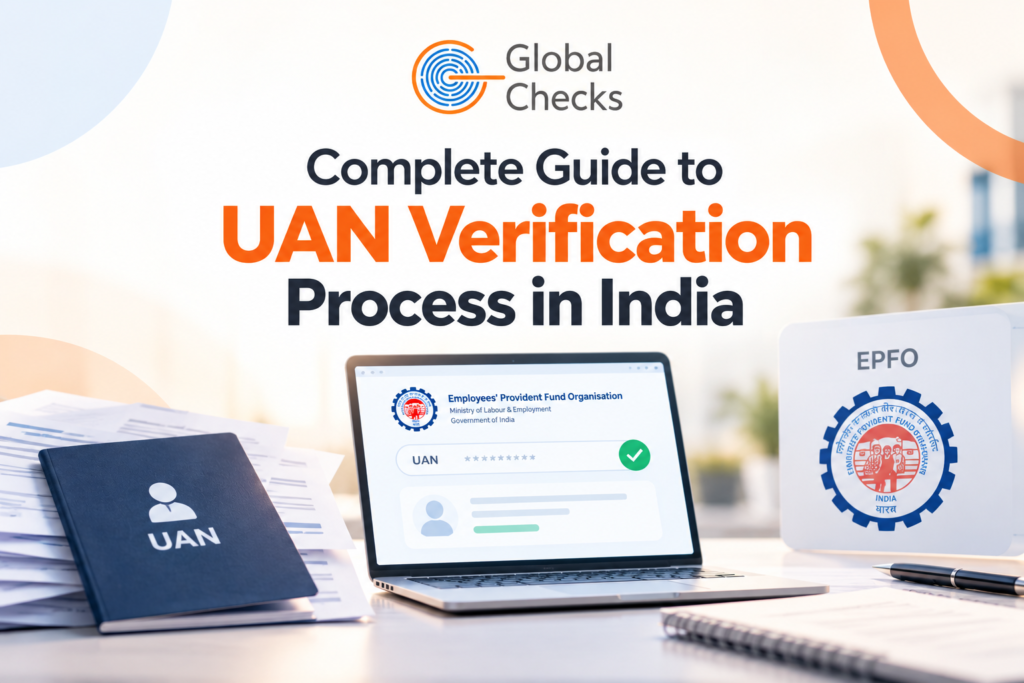
UAN verification is the process of confirming that a candidate’s Universal Account Number is genuine, active, and correctly linked to their EPF and Aadhaar records, rather than taking the number on faith.
The UAN verification process in India has become a standard step for BPOs, staffing firms, IT services, and regulated finance. This guide covers how the check works, what it can and cannot prove, and closes with a UAN verification checklist for employers.
What Is UAN Verification?
The Universal Account Number is a 12-digit identifier issued by the Employees’ Provident Fund Organisation (EPFO) to every contributing member.
At a basic level, UAN verification confirms three things: the UAN exists, it is active, and the identity and employment details attached to it match what the candidate has claimed. What makes UAN verification useful is where that data comes from. PF entries are filed by employers with EPFO, so a candidate cannot fabricate them the way they might a relieving letter.
That matters because employment history is where discrepancies concentrate. EY’s 2025 study, The First Firewall, found that in financial services, 71% of discrepant profiles were flagged during employment checks, while in healthcare, 83% of candidates with discrepant profiles failed employment checks.
Benefits of UAN Verification for Employers
The benefits of UAN verification come from one structural fact: PF records are created independently of the resume. That independence is what UAN verification adds to hiring:
- Employer-filed evidence: Entries come from past employers, making them a sound input for any fake experience check.
- Earlier catches: PF-linked details are reviewed before an offer, not after payroll surfaces a mismatch.
- Defensible decisions: A government-held record is harder to dispute than a reference call.
The benefits of UAN verification also stop at a clear boundary. The check confirms PF-linked employment and nothing outside the PF net.
UAN Verification Process in India: Step by Step
- Obtain the PF data through the candidate: EPFO gives employers no facility to query another person’s contribution history. The passbook and service history sit behind the member’s own login, which only works once the UAN is activated. In practice, the candidate produces their passbook or the Member Service History view from the revamped EPFO portal, or a verification partner runs a member-consented pull.
- Confirm activation status: An allotted UAN is not an activated one. Under EPFO’s circular of 30 July 2025, UAN allotment and activation moved exclusively to the UMANG app using Aadhaar Face Authentication from 1 August 2025 and the portal option was removed in the July 2026 revamp. Aadhaar OTP activation no longer applies. If the UAN is inactive, direct the candidate to UMANG, then EPFO Services, then UAN Services Through Face Auth.
- Run a UAN-linked-to-Aadhaar check: EPFO seeds Aadhaar against KYC records, so this confirms the number is tied to a verified identity rather than a placeholder profile.
- Review PF-linked employment history: against the dates and designations the candidate has claimed.
- Run a duplicate UAN check: Job changes occasionally leave a member with two numbers when a new employer fails to link to the existing one.
- Document the outcome: for future compliance review.
UAN Verification Documents Required
The list of UAN verification documents required at the offer stage is short:
- The UAN and the candidate’s full name as registered with EPFO
- Aadhaar details, since the UAN linked to Aadhaar check depends on matching identity fields
- Claimed employment dates, designations, and employer names
- A signed consent form authorising the employer or verification partner to access EPF-linked data
That consent should be specific about purpose and retention, not a blanket authorisation. Substantive obligations under the DPDP Rules commence on 13 May 2027, so any form built now should meet that standard. Section 7(i) of the DPDP Act also recognises employment-related processing as a lawful ground; consent is the right operating standard for defensibility, not the only legal route.
Duplicate UAN Check and Aadhaar Linkage
Duplicate UANs: Blocking an extra UAN and moving its balance are separate steps. The duplicate can be blocked, but contributions do not merge on their own; the member has to file a transfer claim to move the earlier balance into the active UAN. An unresolved second number can mean a broken contribution trail or, occasionally, an attempt to obscure an employment gap.
Aadhaar linkage: EPFO has tightened Aadhaar-seeding requirements for processing contributions and claims. A UAN without a valid Aadhaar link is a signal to slow down, since it usually means the account was never fully activated.
Fake Experience Check: Where UAN Data Actually Helps
A fake experience check built only on resumes and reference calls has an obvious weak point: both can be coached. PF data is harder to game because employers file it with EPFO, so an inflated tenure or invented employer tends to surface once PF-linked dates are compared against the resume.
A gap, however, is not proof of dishonesty. Genuine employment can sit outside EPFO records when:
- The employer defaulted on PF filings
- The candidate was a consultant or contract worker never on a PF roll
- The establishment was below the statutory EPF coverage threshold
- The employee earned above the wage ceiling and was never enrolled
- The role was in government service covered by GPF rather than EPFO
Treating every gap as a red flag rejects candidates who did nothing wrong. Ask for alternative evidence, such as appointment letters or salary slips, first.
UAN Verification Checklist for Employers
Before finalising an offer, confirm:
- UAN and registered name match the application
- Account status is active, not merely allotted
- Aadhaar seeding is complete
- PF contribution dates match claimed history, with any gap explained
- No duplicate UAN issue is pending
- KYC details are current and free of mismatches
- Purpose-specific consent is on file
UAN Verification for Banking/Finance Hiring
Few sectors lean on this check as heavily as regulated finance. RBI’s KYC Directions for commercial banks require an adequate screening mechanism as an integral part of personnel recruitment. UAN verification gives banking and finance compliance teams a documented, EPFO-backed data point for that screening, which matters where roles involve direct access to money movement and customer data.
The Numbers Behind the Case for Verification
Two official figures show why UAN verification starts with a status check:
- In FY 2024-25, EPFO allotted 1.26 crore new UANs, but only 44.68 lakh (35.3%) were activated by members that year, per the Ministry of Labour and Employment. That gap reflects account status, not candidate intent, which is exactly why status should be checked rather than assumed.
- EPFO recorded a net addition of 21.89 lakh members in June 2025 (Ministry of Labour and Employment, via PIB, an indication of the scale of PF-linked records employers draw on.
Read more: The Complete Guide to Employment Verification in India for HR Teams
Conclusion
UAN verification has become a baseline hiring step across BPOs, staffing firms, IT services, and regulated finance. Run through a consistent UAN verification process in India, built on candidate-produced or consented data and a UAN verification checklist for employers, it confirms identity, account status, and PF-linked employment through records a candidate cannot easily alter, while leaving room for legitimate gaps PF data will never capture.
Frequently Asked Questions
The extra UAN can be blocked, but its balance does not move on its own. The candidate must file a transfer claim to shift earlier contributions into the active UAN, so employers should flag the duplicate for the candidate to resolve with EPFO.
PF contributions are filed by employers, so comparing them against a resume is a reliable way to test claimed tenure. Gaps still need context, since contract work, government service, and uncovered establishments fall outside EPFO records.
The UAN, the name registered with EPFO, Aadhaar details, claimed employment dates and employers, and a signed consent form specific to the purpose and retention.
No. It helps any employer where PF history is the only independent record of past employment.
RBI expects regulated entities to screen staff during recruitment, and many roles involve direct access to funds, so a documented, EPFO-backed employment trail carries more weight.