India’s recruitment space faces challenges twofold in nature. Firstly, credential tampering continues to grow at a steady pace within all industries, while secondly, India’s Digital Personal Data Protection Act, 2023 (DPDP Act) has been introduced and is the most stringent data protection framework in India, complete with a maximum fine of ₹250 crore for infractions.
In a recent EY report (May 2025), which covered over one million pre-employment screenings, it emerged that employment fraud is not a problem of rookies alone; rather, it is professional veterans who are now perpetrating the act. For HR and compliance managers, this poses a difficult balancing act: be diligent but also adhere to the laws.
This guide will cover every aspect of DPDP Act background verification from consent mechanics to data retention, so your organization stays protected on both fronts. Whether you are building your first DPDP Act background verification policy or auditing an existing one, this is your starting point.
What Is the DPDP Act, and Why Does It Matter for Background Checks?
The Digital Personal Data Protection Act received Presidential Assent on August 11, 2023, and its implementing rules were officially notified on November 13, 2025, by the Ministry of Electronics and Information Technology (MeitY). Full compliance with all provisions is expected by May 13, 2027, as part of a phased rollout.
At its core, the Act governs how “Data Fiduciaries” collect, process, store, and delete the personal data of “Data Principals” (your candidates and employees). For employers, the DPDP Act background verification sits right at this intersection; it involves collecting sensitive personal data with a specific purpose and a defined legal obligation attached to every step.
Key terms every HR leader must know:
- Employer: Data Fiduciary: Why and for what purpose the data is processed
- Candidate/Employee: Data Principal whose data is being processed
- Third Party BGV Agency: Data Processor: Who processes the data on your behalf
- Data Protection Board: DPB- Enforcement and Adjudicatory Authority
The DPDP Act applies to all digital personal data processed in India and since virtually all background checks involve digital documents, Aadhaar-linked verifications, and online databases, every background check your organization runs now falls squarely under this framework. Understanding DPDP Act background verification obligations from the outset is what separates compliant hiring from costly exposure. Organisations that invest in getting DPDP Act background verification right early are far better positioned when enforcement ramps up.
How DPDP Act Background Verification Works: The Legal Framework
1. Lawful Basis for Processing
Under the DPDP Act, processing personal data is permitted either with voluntary, informed consent or for a legitimate use such as fulfilling a legal obligation or a contractual requirement.
For background checks:
- Pre-employment checks (before an offer is accepted) require explicit, purpose-specific consent from the candidate
- Post-offer checks linked to the employment contract may qualify as legitimate use, but consent remains the safest and most defensible approach
- Checks on sensitive data (criminal records, health information, financial history) always require explicit consent
2. The Notice Requirement (Section 8)
Section 8 of the DPDP Act makes it mandatory that, before collecting any data for background verification compliance, India mandates that candidates receive a clear, pre-processing notice that specifies:
- What data is being collected (name, Aadhaar, PAN, education certificates, past employer details, etc)
- Why it is being collected (employment verification, integrity due diligence, regulatory requirement)
- Who will process it (internal HR team, third-party BGV agency, their sub-processors)
- How long will it be retained
- The candidate’s rights under the Act (access, correction, grievance redressal)
The DPDP Rules 2025 require notices to be in plain language, available in at least English and one scheduled regional language. Legal jargon buried in a 10-page offer letter does not qualify.
3. Employee Consent Under DPDP: Getting It Right
Employee consent under DPDP is the cornerstone of lawful background verification. The Act defines valid consent as:
- Free: not coerced by conditioning employment solely on consent for optional checks
- Specific: each type of check requires separate consent (education, employment history, criminal, credit)
- Informed: the candidate knows what is being done with their data
- Unambiguous: silence, pre-ticked boxes, or bundled clauses do not qualify
- Withdrawable: the candidate must be able to withdraw consent, and this right must be communicated upfront
What this means practically: A single-line clause in your offer letter saying “by signing, you consent to all background checks” is no longer sufficient. You need a dedicated, itemized consent form for background verification, separate from your employment agreement.
Read More – Understanding the Background Verification (BGV) Process: Steps, Documents & More
Data Privacy in Background Checks: What Employers Must Do Differently
1. Principle of Data Minimization
The issue of data privacy in BGV checks comes from only collecting the data that is necessary to achieve the objective in the first place. For example, if your objective was to confirm whether the candidate had completed his education successfully, you didn’t need his medical records. Similarly, if you were checking his criminal record, you didn’t require any records of his financial dealings.
Most companies collect far more information than required because their BGV partners run standardized processes without customization. Under the DPDP Act, this excess collection is a direct compliance risk and a core concern for DPDP compliance for employers who want to stay audit-ready.
2. Third-Party BGV Agencies as Data Processors
When you engage a background verification agency, that agency becomes your Data Processor under the DPDP Act. DPDP compliance for employers includes ensuring that your BGV partners:
- Process data only as per your documented instructions
- Maintain adequate data security standards (aligned with ISO/IEC 27001 or equivalent)
- Do not sub-process data without your knowledge and consent
- Return or delete data after the purpose is fulfilled
This means your BGV vendor contracts must be updated to include Data Processing Agreements (DPAs) that comply with the DPDP Act. Verbal or informal arrangements are no longer sufficient
3. Data Privacy in Background Checks: Retention and Deletion
One of the most overlooked aspects of data privacy in background checks is retention. The DPDP Act requires personal data to be deleted once the purpose for which it was collected is fulfilled, unless retention is required by law.
For background verification:
- Rejected candidates: Data should generally be deleted within 90–180 days post-rejection (unless sector-specific regulations mandate longer retention)
- Hired employees: Background check records can be retained for the duration of employment and a defined period post-separation (typically aligned with the applicable Limitation Act period of 3 years)
- Data from third-party checks: Must be returned to you by the BGV agency and not retained on their systems beyond agreed timelines
DPDP Compliance for Employers: A Practical Checklist
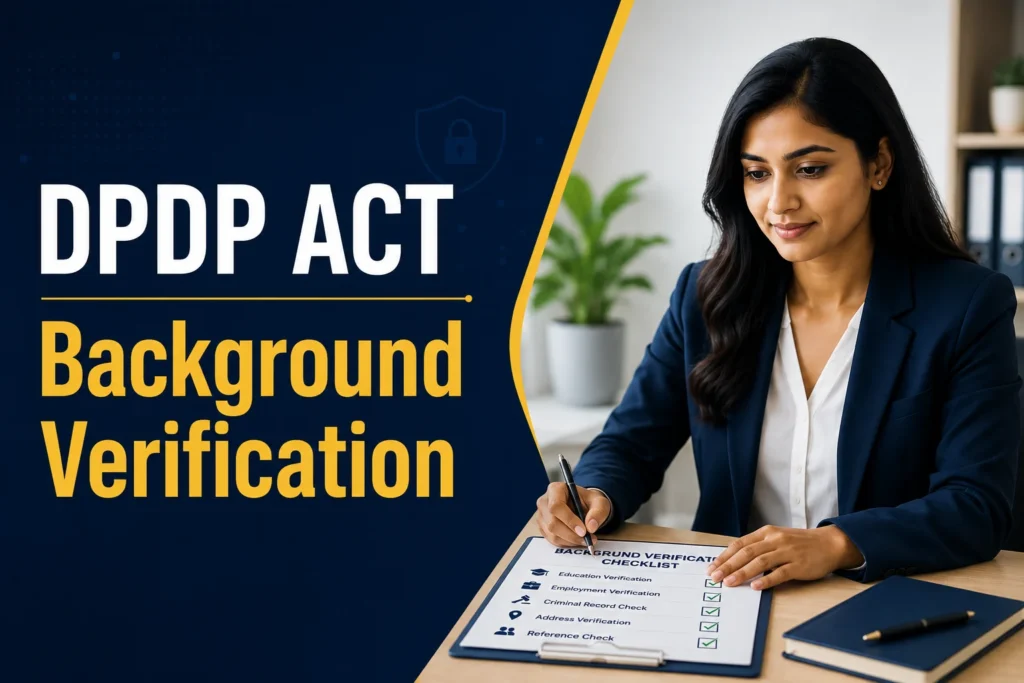
Here is a practical compliance framework for the DPDP Act background verification:
1. Before the Check:
- Develop a self-standing BGV consent form with tick boxes for education, employment, criminal, financial, and address
- Provide a notice before the processing of information consistent with the language requirements of DPDP
- Gain written consent, time-stamped, and stored electronically before any check
- Inform the individual about withdrawing their consent and its implications
2. During the Check:
- Only share the minimal amount of data with your BGV provider
- Make sure that the BGV provider has a DPA in place
- Create an audit trail of who accessed the candidate’s information and when
- Inform the candidate if there are any significant differences found that could impact their job offer
3. After the Check:
- Establish and implement a data retention schedule for BGV records
- Establish a system that enables candidates and employees to view or update their BGV data
- Permanently remove the data from internal and vendor systems upon completion of the retention period
- Train HR and hiring managers on DPDP requirements annually
Employee Consent Under DPDP: Special Scenarios
1. What If a Candidate Refuses Consent?
It should be borne in mind that in DPDP consent is mandatory; however, in positions in industries where there are certain mandatory checks, such checks will be considered legally required and, thus, do not need consent. In the case of mandatory checks, an organization can simply choose not to move forward with a candidate if he/she refuses to provide consent. The thing you cannot do is misrepresent that someone gave consent.
2. Minors in Internship or Part-Time Roles
If you are hiring interns or part-time staff under 18, Section 16 of the DPDP Act requires verifiable parental or guardian consent before processing their data for any background check. Standard BGV consent forms are not sufficient for this category.
3. Re-verification and Periodic Checks
For roles that require periodic re-verification (e.g., senior financial roles, access-sensitive positions), employee consent under DPDP must be separately obtained for each re-verification cycle. Consent given at onboarding does not automatically cover checks conducted two years later.
Read More – Employee Background Check: How Long Does It Take and What’s Included
Background Verification Compliance India: Sector-Specific Considerations
Different sectors in India face additional regulatory requirements layered on top of the DPDP Act. Background verification compliance in India is not a one-size-fits-all exercise, sector regulators add their own obligations on top of the DPDP framework:
| Sector | Additional Requirement |
|---|---|
| BFSI | RBI KYC norms, SEBI background check guidelines for intermediaries |
| IT/ITeS | Client contract requirements often mandate specific BGV standards |
| Healthcare | Medical Council registration verification, license validation |
| Government Contractors | Security clearance processes with specific data handling rules |
| Staffing/RPO Firms | Act as both Data Fiduciary (for their employees) and Data Processor (for client organizations) |
Penalties for Non-Compliance
The financial stakes of getting DPDP Act background verification wrong are severe:
| Violation | Maximum Penalty |
|---|---|
| Processing data without valid consent | Up to ₹250 crore |
| Failure to notify of a data breach | Up to ₹200 crore |
| Inadequate security safeguards | Up to ₹250 crore |
| Children's data violations (internship hires under 18) | Up to ₹200 crore |
| General obligations breach | Up to ₹50 crore |
Beyond financial penalties, non-compliance creates reputational risk, particularly in sectors where enterprise clients conduct compliance audits of their vendor and partner organizations.
Conclusion
The DPDP Rules 2025 established a schedule for compliance implementation, with total compliance expected no later than May 13, 2027. By 2026, significant parts of the Rules will have already taken effect, such as the operation of the Data Protection Board and breach reporting requirements. The time to act is dwindling rather than expanding.
For Human Resources and compliance executives, the lesson should be clear: DPDP Act background verification preparation does not end when it is done. It is an activity that needs continuous review. As roles change, consent forms should be updated. As vendors are changed out due to business needs, vendor agreements should be re-audited. As the lifecycle of employees ends, retention policies need to be followed. Every new recruitment cohort is another wave of responsibilities under DPDP.
Frequently Asked Questions (FAQs)
Yes. A reference to background checks in an offer letter does not constitute valid employee consent under DPDP. The Act requires a separate, specific, informed consent, not a bundled clause in a larger document. You need a dedicated BGV consent form.
No. DPDP Act background verification compliance requires that consent be specific to each type of check. A single omnibus form may be challenged as non-compliant. Best practice is to itemize each check type (education, employment, criminal, credit, reference) with individual consent acknowledgements.
Yes, you must stop processing for the purpose covered by the withdrawn consent. However, if the check has already been completed and the results are on record, you must disclose how that data will be handled. You cannot use withdrawal as a basis for discrimination, but you may factor it into the hiring decision if the check was a stated requirement for the role. Read more on consent withdrawal obligations under DPDP.